
REVIEW · EDINBURGH
Ghosts of Edinburgh: Bloody Past Exploration Game and Tour
Book on Viator →Operated by Questo · Bookable on Viator
Edinburgh gets spooky with a phone game. I like how self-paced it feels as you wander from landmark to landmark, solving clue-style challenges tied to the city’s legends. I also love that it works offline, so you can keep going without hunting for signal while you explore.
The big thing to consider is that you’re doing it yourself: some clues require careful looking and a bit of walking between points, and if your app has trouble loading, your timing can suffer.
In This Review
- Key Highlights at a Glance
- How This Ghost Game Works (and Why It Fits Real Travel)
- Your Walk Begins at The Mound (Prince Street’s Big Slope Story)
- Edinburgh Castle Without the Hassle of a Tour Group
- St Giles: When a Church Became Edinburgh’s Patron
- Mary King’s Close: Under the Royal Mile
- Greyfriars Bobby Fountain: A Statue With a Story to Match
- Grassmarket: From Cattle Market to Execution Ground
- New College and Old College: Education and Belief in Stone
- New College (Free Church Theology)
- Old College (University of Edinburgh)
- Modern Art Stops: A Sharp Contrast in the Middle of Ghosts
- Ending at 100 W Bow: Finish the Game, Keep Wandering
- Price and Time: Is $7.21 Worth Your Hour?
- Who This Works Best For (and Who Should Skip It)
- Practical Tips to Make It Feel Smooth
- Should You Book Ghosts of Edinburgh?
- FAQ
- Do I need internet to play this ghost game?
- Can I start at any time and take breaks?
- Do I need to enter paid attractions like Edinburgh Castle?
- How long does the game take?
- Is this a private activity for my group?
- Is the game offered in English, and are service animals allowed?
Key Highlights at a Glance

- Start and stop on your schedule without waiting for a set tour time
- Play offline, so you’re not stuck when data is slow
- Family-friendly scares, more fun puzzles than heavy horror
- Edinburgh landmarks, one by one, with stories that connect the places
- No guide needed, just your mobile ticket and the game interface
How This Ghost Game Works (and Why It Fits Real Travel)

This is a self-guided experience built like a city game. You’re not following a live lecturer on a fixed script. Instead, you move through Edinburgh at your pace, using your phone to follow the next challenge, solve what you need, then continue onward. That’s a smart match for travel days when your energy is high in the morning and low after lunch—or when you want to stop for a coffee and take a breather.
You also get flexibility that traditional group tours rarely offer. You can pick your start time, take breaks, and resume later. After booking, you can play it without rescheduling, which is handy when your sightseeing plans shift due to weather or your own wanderings.
One more practical advantage: it can run without internet. That matters in Edinburgh, where you’ll often be surrounded by stone buildings and streets that love to mess with reception. If you want the game to feel smooth, treat your phone battery like it’s part of your backpack.
You can also read our reviews of more tours and experiences in Edinburgh



Your Walk Begins at The Mound (Prince Street’s Big Slope Story)
You start at The Mound, that dramatic artificial slope that links Edinburgh’s New Town and Old Town. Even before you get into ghost stories, the place itself is a neat lesson in how Edinburgh was reshaped. The Mound was created using earth excavated from New Town foundations—piled into what used to be Nor Loch. Nor Loch was drained in 1765, and the result is today’s Princes Street Gardens.
In the game, this stop sets the tone. You’re asked to hunt for answers around the area, so you’re not just admiring views—you’re actually studying the details around you. If you like getting your bearings fast, The Mound is a good opener because it naturally puts you in the right part of town for moving forward.
Tip: wear shoes you can handle on uneven ground. The game-style pace is still a walking route, even if it’s flexible.
Edinburgh Castle Without the Hassle of a Tour Group

Next, you’re pointed toward Edinburgh Castle, perched on Castle Rock and dominating the skyline. The rock itself has evidence of human occupation going back at least to the Iron Age, so the site feels heavy with time even when you’re just passing by.
In a standard tour, you’d get a timeline and be done. Here, you’re slowing down in a different way. You look around the castle area for clue answers tied to the story of the fortress. It’s a good fit if you like doing a bit of detective work instead of passively listening.
One important consideration: the game is designed so that you do not need to enter paid attractions to keep playing. That means you can focus on the spots you can access from outside. If you ever feel like you’re being pushed toward a ticketed entry, you can treat it as a signal to pause, double-check what the game requires, and reach out if something seems off.
St Giles: When a Church Became Edinburgh’s Patron
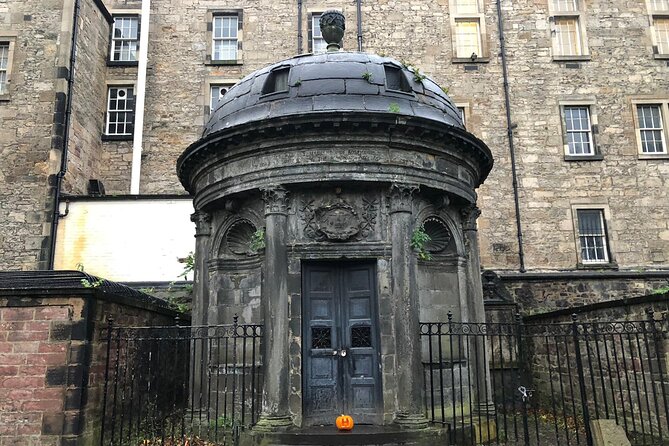
Moving from the castle-feel to the city’s religious heart, you’ll come to St Giles. The church’s origins go back to about 1130, when a parish church served Edinburgh during the reign of King David I. It was granted to the Lazarites, and it was dedicated to St Giles, the patron saint of lepers—and later closely tied to Edinburgh itself.
The game uses that kind of story to make you pay attention. You don’t just read a plaque and move on. You search for answers tied to the place, which makes the stop feel more active and less like a checklist.
This is one of those moments where the game adds value beyond the scenery: the legend gives you a reason to look closely, and the puzzle gives you a reason to linger without getting bored.
Mary King’s Close: Under the Royal Mile
Then the route drops into a more atmospheric section of Old Town: Mary King’s Close. A close is basically a tight passage under and between buildings, and this one sits beneath the Royal Mile in Edinburgh’s Old Town area. It’s named for Mary King, a merchant burgess who lived there in the 17th century.
What I like about including a close in a ghost-style game is that it instantly changes your sense of scale. Streets can feel open, but a close makes you slow down, look up and down, and imagine everyday life—past lives, in this case—squeezed into narrow space.
In the game, you’re once again hunting for answers on-site. That means you’re not relying on a script. You’re noticing what’s in front of you, which is usually how you end up with better photos and better memories.






Greyfriars Bobby Fountain: A Statue With a Story to Match

Near Greyfriars Kirkyard, you’ll encounter the Greyfriars Bobby Fountain area. The life-size statue of Greyfriars Bobby was created by William Brodie in 1872, funded by local aristocrat Baroness Burdett-Coutts, and unveiled on 15 November 1873.
This stop is a classic Edinburgh combo: a story people recognize and a spot that rewards looking closely. The game-style challenge here works well because Bobby’s presence is visual and immediate. You can orient yourself, then focus on the clue without feeling lost.
If you’re playing at night, this is a great moment to slow down. Even when the mood is spooky, you’re still solving something concrete, which keeps it fun instead of just eerie.
Grassmarket: From Cattle Market to Execution Ground

Next is The Grassmarket, a place with a darker reputation. Dating back to the 1300s, it began with cattle fairs and stables. By around the 1670s, it became a trading point for goods. Then the role shifted again, and it’s remembered as a traditional site of public execution.
The game’s challenge at this stop helps you connect the setting with what happened here, instead of treating it like a backdrop. That’s where a self-guided story game can work better than a rushed narration: you control the pace, and you decide how long to sit with the grimness before moving on.
Practical note: this is a good place to check your footing. Old streets and sloped areas can be slick depending on weather.
New College and Old College: Education and Belief in Stone
Two school-and-church related buildings come next, and they give the route a sharper Edinburgh flavor: the way religion, politics, and education shaped the city.
New College (Free Church Theology)
New College was founded as the theological college of the Free Church of Scotland. Classes began in Edinburgh’s New Town on 1 November 1843, then the college moved to the Mound soon after. The foundation stone for the current building was laid on 3 June 1846 by Rev Dr Thomas Chalmers.
In the game, you’ll search the area for clue answers tied to these story beats. I like this stop because it shows a different side of Edinburgh than castle and closes. You get an architectural and institutional Edinburgh, built with purpose.
Old College (University of Edinburgh)
Old College is part of the University of Edinburgh, sitting on South Bridge. It currently houses administration areas, the University of Edinburgh School of Law, and the Talbot Rice Gallery. Originally called the New College, it was designed by Robert Adam to replace older buildings.
This pair of stops is useful if you like continuity. You can sense how the city grows and repurposes its own buildings—while the game pushes you to keep attention on the details.
Modern Art Stops: A Sharp Contrast in the Middle of Ghosts
After the older corners of town, you’ll hit a more modern feeling: the Scottish National Gallery of Modern Art. It first opened in August 1960 at Inverleith House in the Royal Botanic Garden. It moved to its current site at Modern One on Belford Road in 1984. In March 1999, Modern Two opened across the road.
The neat trick here is tone. You’re still in a ghost-themed game, but the story locations broaden beyond medieval drama. That contrast keeps the walk from feeling like one long grim mood. Instead, the route feels like Edinburgh itself—layers, time jumps, and different kinds of curiosity.
In the game portion, you’ll still be looking for answers. So even in a modern art setting, the activity stays consistent: slow down, observe, solve.
Ending at 100 W Bow: Finish the Game, Keep Wandering
The experience ends at 100 W Bow, in central Edinburgh. Think of it as a clean finish line: you’ll have completed the game’s story loop and your final clue spot will bring you right to that endpoint.
From there, you don’t have to rush. This is the kind of activity where the best moments often happen after you finish—when you decide to go back for one more photo, one more street, or one more quick stop for a snack before dinner.
Price and Time: Is $7.21 Worth Your Hour?
At about $7.21 per person for roughly 1 hour (approx.), this can be great value—especially because it’s not a one-and-done walk. You can start when you want, pause when you want, and continue later. That flexibility is worth real money if your schedule tends to drift.
You also get offline play and a mobile ticket, which lowers the friction of doing it last-minute or during a busy day. No live guide means you’re paying for the experience design and the game interface, not for a person’s time slot. For friends or families who enjoy a bit of teamwork, the hour can feel longer in a good way.
The trade-off is that it’s only as smooth as your phone and your comfort with puzzle-style searching. If you’re the kind of person who wants a guide to keep the group together, you might find yourself doing more solo problem-solving than expected.
Who This Works Best For (and Who Should Skip It)
I’d point this toward you if:
- you like light spooky themes without heavy scares
- you enjoy solving clues and puzzles
- you’re traveling with a group that likes walking and taking breaks
- you want Edinburgh landmarks tied to story, not just a straight sightseeing list
It might not fit as well if:
- you need a live guide to explain everything in plain language
- you’re not into mobile apps or you worry about tech failures
- you prefer a route where you never have to search for answers
If you do have app concerns, set yourself up. Charge your phone before you start. Consider downloading any game support files if prompted. And keep your expectations realistic: this is a self-guided game, not a scripted escorted tour.
Practical Tips to Make It Feel Smooth
Here are a few things that tend to make this type of experience go better for you:
- Go with good light if you’re new to the route. Night can be fun, but if you’re reading clues on your phone, dim light can make everything harder.
- Assume you’ll walk between clue points. Some parts may feel spread out, so plan on a solid hour of moving.
- If you get stuck, change your viewing angle. A lot of clue hunts work better when you reposition and look around carefully.
- Don’t plan to rely on paid entry sites. The game is designed so you can play without entering ticketed attractions.
- Keep the phone battery sacred. You’ll be using the interface throughout, so low battery is the easiest way to ruin the vibe.
Should You Book Ghosts of Edinburgh?
If you want Edinburgh in story form, but you don’t want to be locked into a rigid group schedule, I think this is a smart pick. The offline option and the ability to pause and restart make it practical. The landmarks included are the kind you’ll remember, and the puzzle format keeps you actively engaged instead of passive.
I’d only hesitate if you strongly prefer live guidance, or if you know you get stressed when an app doesn’t load quickly. Otherwise, for families and friends who enjoy a bit of spooky play, it’s an easy way to turn one hour into an experience you’ll talk about afterward.
FAQ
Do I need internet to play this ghost game?
No. You can play offline, so you do not need an internet connection to run the game.
Can I start at any time and take breaks?
Yes. You can start at any hour, take a break at any time, then resume later. You also can play it anytime after booking without rescheduling.
Do I need to enter paid attractions like Edinburgh Castle?
The experience is designed so that entrance to paid attractions is not required to play the games. You can keep playing without entering ticketed locations.
How long does the game take?
It’s listed as about 1 hour (approx.).
Is this a private activity for my group?
Yes. It’s described as a private tour/activity, so only your group participates.
Is the game offered in English, and are service animals allowed?
The experience is offered in English, and service animals are allowed. It also notes that most travelers can participate.